

TLDR:
Kobe woke up at 4am. Four sessions a day instead of two. After five or six years, nobody could catch up. Didn’t matter what they did.
Ramp just published data from 50,000+ companies that shows the same pattern. AI adopters have doubled their revenue since 2022. Non-adopters are flat.
The gap is compounding. And compound curves don’t send a warning before they bend.
Kobe Bryant used to explain his edge in the simplest terms.
If your job is to be the best basketball player you can be, you have to train. Most guys wake up at 10, train from noon to 2, let the body recover, go again from 6 to 8. Two sessions.
Kobe woke up at 4. Trained from 4 to 6. Back at it from 9 to 11. Again from 2 to 4. Again from 7 to 9. Four sessions.
Do that for a few years and the separation with your competitors grows larger and larger and larger. By year five or six, it doesn’t matter what kind of work they’re doing in the summer. They’re never catching up.
I thought about Kobe this week when I saw a chart that stopped me mid-scroll. Eric Glyman, Ramp’s CEO, posted spending data from over 50,000 businesses on the platform. Three lines, indexed to November 2022.
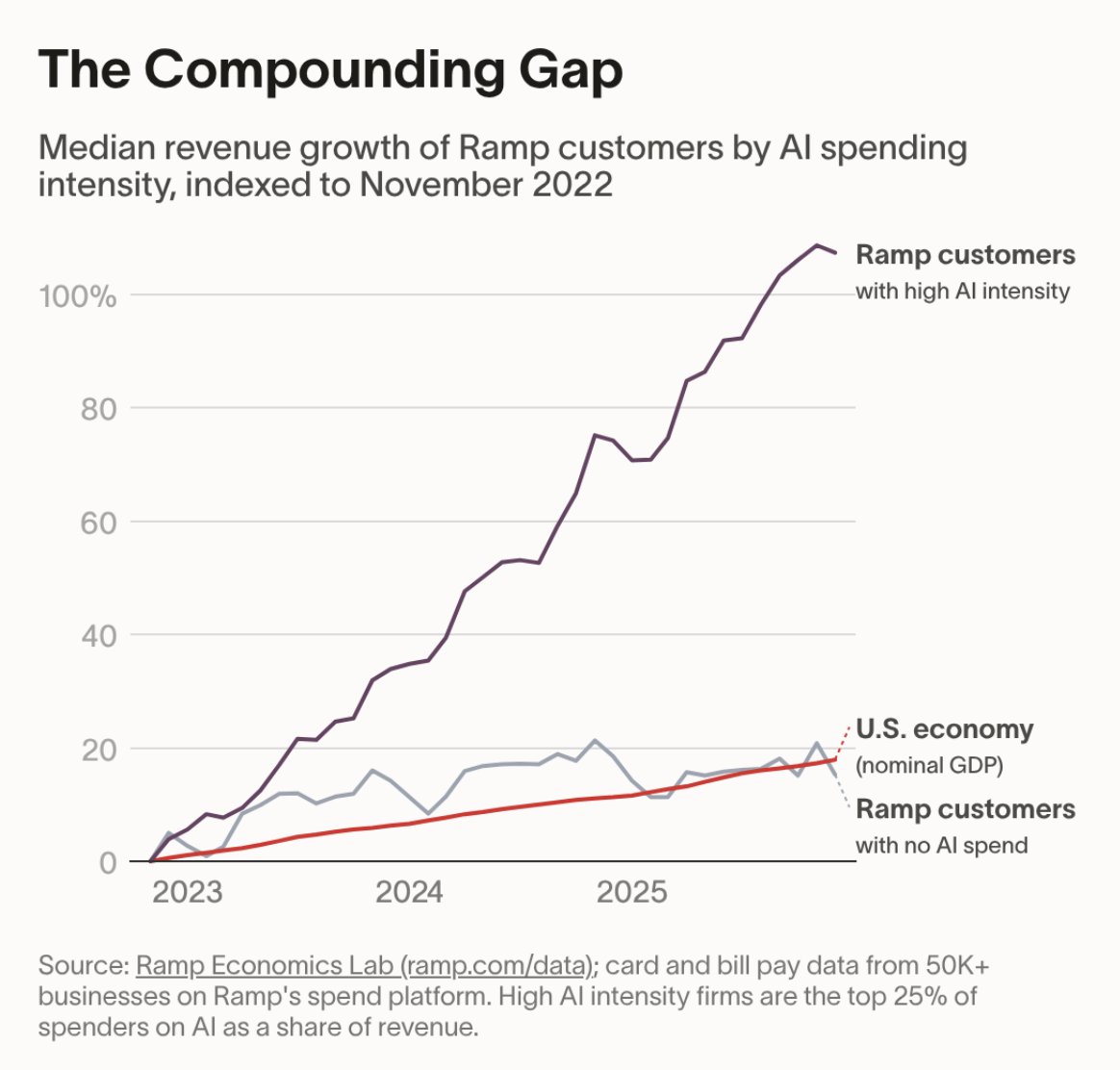
The top line: Ramp customers with high AI spending intensity. Revenue up over 100%. The curve is accelerating.The bottom line: Ramp customers with no AI spend. Essentially flat. Tracking just below nominal GDP growth.
And in the middle, the U.S. economy. Plodding along at roughly 20% cumulative growth over the same period.
Three lines. Three trajectories. One economy splitting in two.
Glyman wrapped the data in a Shackleton analogy, the ice cracking beneath the camp, men on the wrong side of the divide watching the gap widen until it’s too far to jump. I like the metaphor. But I think the more interesting story is in the shape of the curves themselves.
Look at the red line. The companies with no AI spend. They’re not collapsing. They’re growing, just barely. That’s the dangerous part. Revenue is still coming in. The lights are still on. There’s no alarm bell, no emergency board meeting, no reason to panic.
I listened to Cyan Banister on a podcast a while back, telling the story of her early years on the streets. She almost froze to death once, as a teenager. And the thing that stayed with me: contrary to what you’d expect, it felt like a warm hug. She was getting sleepy, comfortable, happy. That’s the sign you’re dying. Hypothermia doesn’t announce itself with pain. It wraps you in comfort right before it takes you out.
That’s what the red line on this chart looks like.
The companies on the top line didn’t start there. In early 2023, the gap was almost invisible. A few percentage points. Easy to dismiss as noise. Now it’s a canyon. And the thing about compound curves is they don’t send you a warning before they bend. Just like Kobe’s edge, it builds quietly until it’s insurmountable.
This is the pattern I keep running into. When we built our AI readiness assessments across companies and industries, the average score was 3.25 out of 10. Leaders consistently outpaced their organizations. And the companies that thought they were “doing AI” because they had a Copilot license were often the least prepared for what’s actually coming. Access is not advantage. Having the tool is not using it. Using it is not thinking differently because of it.
Ramp’s data puts a revenue curve on that gap. And the curve is exponential, which means the cost of waiting another quarter isn’t linear. It compounds.
I wrote a while back about the arbitrage window that just opened, and how the businesses rebuilding from first principles would create moats so wide that late adopters won’t be able to see across them. Glyman’s chart is the first large-scale dataset I’ve seen that shows this in actual revenue terms. The moat is already forming. The companies on the wrong side of that red line aren’t failing yet. They’re just falling behind at a rate that makes catching up progressively harder.
The construction examples in Glyman’s post are worth sitting with. A roofing company in Texas. A window installer in Utah. A five-person firm in Florida doing $20M in revenue. These are not tech companies. They’re not in Silicon Valley. They’re running LLMs for estimates, proposals, contract drafting. And they’re growing 24%, 59%, 65%.
The AI transformation story has been told mostly through the lens of big tech and startups. Ramp’s data suggests the real story might be in the trades, in services, in the thousands of small operators who figured it out while everyone else was still debating whether ChatGPT is a fad.
And remember: Ramp’s customer base skews toward early adopters and fast-growing companies. Glyman acknowledges this. Which means the broader economy likely looks even starker. The gap in the chart is probably the optimistic version.
What’s different about this moment is that the cost of jumping has never been lower. The tools are accessible. The barrier is psychological, not technical. You don’t need a CTO, a budget cycle, or a board resolution. You need curiosity and a few hours.
Kobe’s competitors had access to the same gym. The same courts. The same trainers.
The difference was who showed up at 4am.
The chart says it all. Same economy, same starting point, two groups of companies diverging at an accelerating rate.
The question is which line you’re on. For CEOs ready to close the gap, AI coaching built for executive decision-makers is the most direct starting point. And for a concrete look at what the compounding gap means when it’s time to exit, read Before You Sell.
We’re Exponential Partners. We help companies understand which side of the gap they’re on and build a strategy and products to stay on the right one. If you’re interested in exploring what AI means for your organization, visit us at exponentialpartners.io
