
I've heard it quite a bit and even more since yesterday. People ask ChatGPT or Claude now, so nobody needs search, so Google is finished, Halloween zombie material, right?
Yesterday Alphabet reported its quarter, and I went through the numbers. I think the people writing Google off are looking at one product and missing the company. Here is why I think Google ends up one of the winners of AI, whatever happens to the search box.
The All-In hosts have spent a lot of time sizing up what search is really worth to Google. Their conclusion is that Google wins in AI regardless of search.
The Coca-Cola Line
It reminds me of another line. Sugary drinks are bad for you, hence the Coca-Cola Company will go bankrupt. That one misses how much more there is to Coca-Cola than the drink.
Coca-Cola sells in more than 200 countries and territories, about 2.2 billion servings a day. Sparkling soft drinks were 69% of its volume last year, so about 31% was water, sports drinks, coffee, tea, juice and dairy. Trademark Coca-Cola itself was less than half. Low and no-calorie drinks are now 31.4% of volume, and Coke Zero Sugar grew 14% in 2025 while sparkling overall stayed flat. The company owns around 200 master brands. If people drink less sugar, Coca-Cola sells them something else.
I think Google looks a lot like that.
The Bear Case Was Real
To be fair, the bear case was real. In early 2023, one estimate put a ChatGPT answer at about 30 cents of compute, roughly ten times a regular Google search. At that cost, chat couldn't economically replace search. If Google served all its queries that way, the bill would dwarf what it was spending. Chat would only work at Google's scale once the cost of running the models came down a lot.
The cost did come down. In 2025, Sundar Pichai explained that designing its own chips and owning the full stack is how Google keeps the cost per query low.
The Numbers
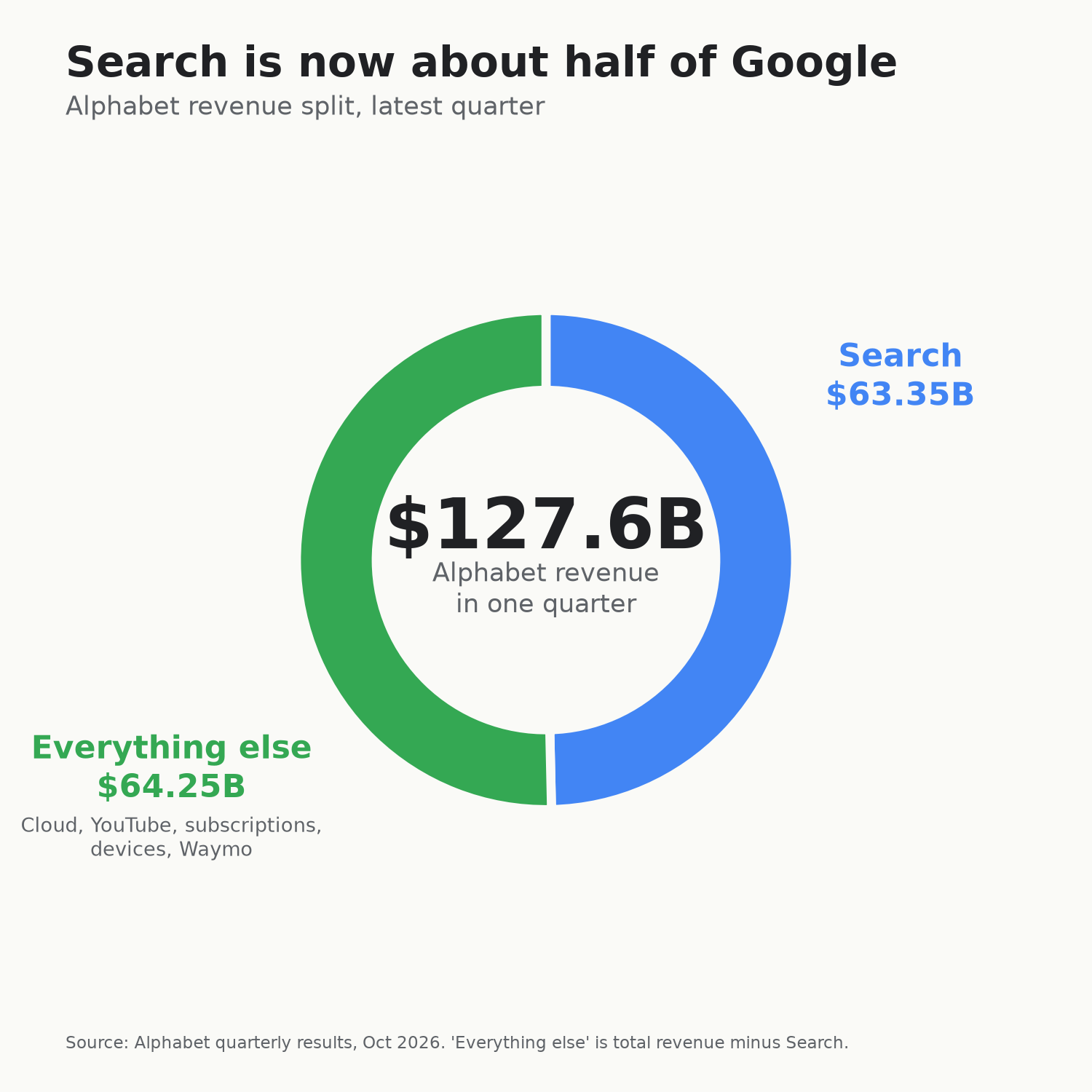
Now the numbers. Revenue was $127.6 billion, up 25% from a year ago. Sundar Pichai described it as a half-trillion dollar revenue run rate.
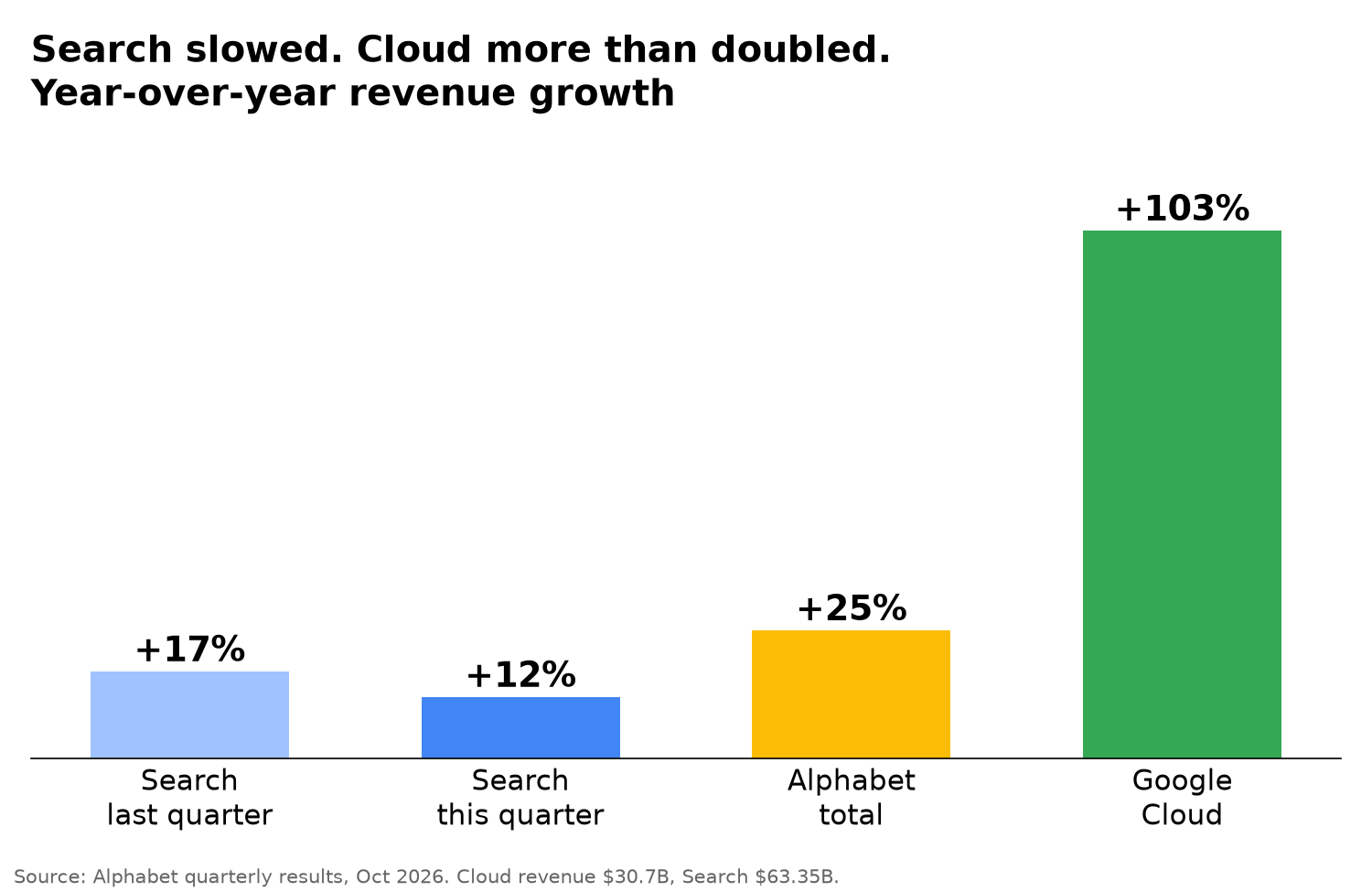
Search, the business everyone says is dying, brought in $63.35 billion, up 12%. Google said query growth was the highest it has been in five years, commercial queries included. In AI Mode, people type questions about three times longer than a classic search, and one in five uses voice, images or documents.
There's an honest counterpoint. Search growth slowed from 17% last quarter to 12% this quarter, and Google said AI Mode makes less money per search for now, which weighed on growth. Search still grew double digits, but the slowdown is there.
Then look at the rest. Google Cloud grew 103% to $30.7 billion, with a 36% operating margin and a $561 billion backlog. The Gemini app reached 1 billion users. Google's own APIs process close to 32 billion tokens a minute, more than four times a year ago. Waymo has passed 300 million fully autonomous miles and operates in 15 US cities.
Search is now about half of Alphabet's revenue. The other half is Cloud, YouTube, subscriptions, devices and Waymo.
Price Per Click to Price Per Token
Google's business has always run on price per click, and Google is very well placed to move that to price per token, through YouTube, Gmail and Workspace. It can win even if search declines.
Google Cloud doesn't care which model wins. It can run anyone's models, and in the worst case Google still has the lowest-cost infrastructure in the world to run them on. Google is also an incredible chip business. The best thing for Google would be hundreds of models spreading, because it makes money at the chip layer whichever one wins.
That's the part people miss when they say search is dead. Every time someone asks an AI a question, a chip somewhere runs it. Google designs its own chips, runs its own cloud, and makes its own models. It earns when you search, and it can earn when you ask a chatbot, even one that someone else built.
Coca-Cola adjusted as people changed what they drink. Google can do the same as people change how they ask.
